2008/09/30

The Race to Shambhala

Buddha the Conqueror (Nicholas Roerich, 1925)

What is Shambhala? A prophecy? A spiritual state? A war cry?
Ancient Buddhist texts of Mongolia predict a time when the whole world will be consumed by suffering - war, injustice and cruelty. Only in mysterious Shambhala will the Buddhist tradition be preserved. A barbarian overlord will attempt to subjugate the world, and the female Buddha, Arya Tara, will reincarnate as his queen. When he imagines to have achieved supreme dominion, the queen will reveal the existence of Shambhala to him. Unable to resist his desire to conquer, he will attack, and face the meritorious reincarnated Shambhala warriors in a final battle.

"Shambhala Rising" by Konchog Norbu (my summary)

mother-of-genghis-khan1933Mother of Genghis Khan (1933)

We raised the yellow flag
For the greatness of the Buddha doctrine;
We, the pupils of the Khutuktu,
Went into the battle of Shambhala!
(Mongolian song from 1919)
Gesar Khan (1941)

Let us die in this war,
To be reborn
As horsemen of the Ruler of Shambhala.
(Mongolian song heard by Nicholas Roerich in 1924)
The Command of Rigden Djapo (1933)

Near Karakorum and on the shores of Ubsa Nor I see the huge multi-colored camps. ... Above them I see the old banners of Jenghiz Khan, of the kings of Tibet, Siam, Afghanistan, and of Indian princes; the sacred signs of all the Lamaite Pontiffs; the coats of arms of the Khans of the Olets; and the simple signs of the north-Mongolian tribes. .... There is the roar and crackling of fire and the ferocious sound of battle. Who is leading these warriors who there beneath the reddened sky are shedding their own and others’ blood? ... I see ... a new great migration of peoples, the last march of the Mongols … (Ferdinand Ossendowski in 1924)

song-of-shambhala1943Song of Shambhala (1943)


There is a lot of weirdness about Shambhala...
Foreign Myths about Shambhala by Alexander Berzin
The Heir of Genghis Khan, a.k.a Storm over Asia, a Soviet silent movie with themes from Mongolian myths and Western ideas about Mongolia
The art of Nicholas Roerich
***


2008/09/22

Ein Sturm weht vom Paradies her

(previously published @historia.ainurin.net June 13, 2007 at 5:40 pm)

paul klee, angelus novus 1920

"Es gibt ein Bild von Klee, das Angelus Novus heißt.

Ein Engel ist darauf dargestellt, der aussieht, als wäre er im Begriff, sich von etwas zu entfernen, worauf er starrt.
Seine Augen sind aufgerissen, sein Mund steht offen, und seine Flügel sind ausgespannt.
Der Engel der Geschichte muß so aussehen.
Er hat das Antlitz der Vergangenheit zugewendet.
Wo eine Kette von Begebenheiten vor uns erscheint, da sieht er eine einzige Katastrophe, die unablässig Trümmer auf Trümmer häuft und sie ihm vor die Füße schleudert.
Er möchte wohl verweilen, die Toten wecken und das Zerschlagene zusammenfügen.
Aber ein Sturm weht vom Paradies her, der sich in seinen Flügeln verfangen hat und so stark ist, dass der Engel sie nicht mehr schließen kann.
Dieser Sturm treibt ihn unaufhaltsam in die Zukunft, der er den Rücken kehrt, während der Trümmerhaufen vor ihm zum Himmel wächst.
Das, was wir den Fortschritt nennen, ist dieser Sturm."

***

Paul Klees Bild hat einen tiefen Eindruck auf Walter Benjamin gemacht. Mir macht seine dramatische Gleichnis einen noch tieferen Eindruck. So kommt mir auch, nach sechs Jahren von Geschichtsstudien, mein Geschichtsbewusstsein vor, wenn ich es in einem Bild zusammenfassen könnte. Ich will, wie jedeR HistorikerIn, so gern Muster und rote Fäden finden, so gern die Fakten ordnen und die Quellen analysieren, so gern die Welt etwas heiler machen. Aber wenn es eine Wahrheit gibt, dann ist es das, was der arme Engel sieht, immer und ewig weitergeht, und das, was wir HistorikerInnen machen, ist nichts anderes als was die Trümmerfrauen in Deutschland 1945 machten - überleben, Tag für Tag kämpfen in unserer kleinen Welt, belächelt und bemitleidet von denen, die glauben, die Zügel der Geschichte in det Hand zu halten. Aber auch sie werden eines Tages wie Stoppeln vor dem Winde und wie Spreu, die der Sturmwind wegführt.

Walter Benjamin
Über den Begriff der Geschichte, These IX a.a.O., S. 697f. 1940
(Quelle)
(Angelus Novus, von Paul Klee)
(Mehr über Walter Benjamin - 1892-1940)

2008/09/06

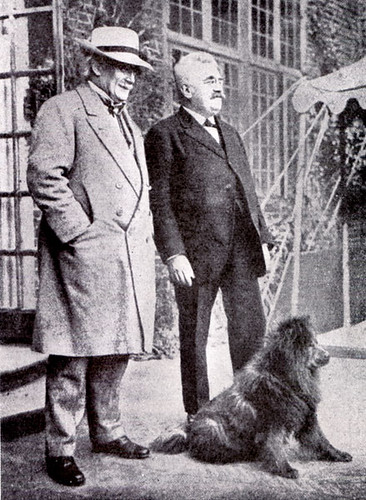
Lloyd George, Millerand, and doggy

At Hythe in May 1920, these two gentlemen raised the war repair payments for Germany by yet another few billions.

From Illusionernas årtionde by Rütger Essén, Bonniers (Stockholm 1940)

2008/09/01

Interesting Blogs

Added some new internet friends to the blogroll:

The Flapper Girl - Feminism, fashion, 1920's, music, culture... In Croatian.

Modärna Tider - Style, events, literature, moving pictures... In Swedish.

How come those people 80 years ago still seem so terribly ahead of their time? For I assure you, I and my friends are not love with the original modern times because we are nostalgic (well, maybe a little), but because we are the very opposite of conservatism...

Though, what's wrong with conserving the good stuff? Maybe it won't taste as fresh... but it will cheer up long winter nights.