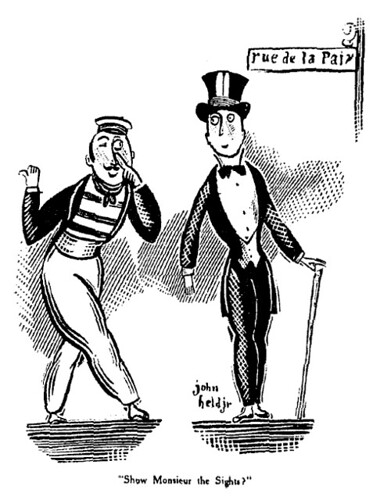
Very early cartoon by John Held Jr. in The New York Times, 1920. His style would develop in a completely different way during the twenties.
You can compare samples of his early and later work here.
Showing posts with label satire. Show all posts
Showing posts with label satire. Show all posts
2009/05/08
"Show Monsieur the sights?"

2009/04/03
Thragnar the Troll King and Dame Guenevere

By Frank C. Pape; from Jurgen by James Branch Cabell (1919).
I first found this picture more than 15 years ago in a German book, Lexikon der Symbole by Wolfgang Bauer, Irmtraud Dümotz and Sergius Golowin. It was used to illustrate (ironically, I assume) the threat of modern society against the sacrosanctity of the family...
Funny if you have read the original story, which it was used to illustrate. It is in the public domain, I believe; the entire text can be read at the University of Virginia's website dedicated to Cabell.
2008/10/08
Veli Giovanni Rotundassa
 Jos olette Helsingin tienoolla, käykää, hyvät ihmiset, Kansalliskirjaston Rotundassa ihailemassa Veli Giovanni-näyttelyä.
Veli Giovanni (synt. Hillari Johannes Viherjuuri, 1889−1949) oli muun muassa pakinoitsija ja pilalehtitoimittaja, mutta hänen suurin saavutuksensa on nerokas keksintö, itse sana "sarjakuva". Veli Giovannin ansiosta suomella on neutraali sana tälle paljon parjatulle taidelajille. Hupisarjakuvien lomassa hän käsikirjoitti myös parisuhdetarinaa Junnusta ja Allista 1920- ja 1930-luvulla, jota Suomen Kuvalehden lukijat seurasivat innolla kuin televisiosarjaa ikään. Veli Giovannin sarjakuvat olivat sopivia koko perheelle, kuten myös oheiskrääsästä käy ilmi. PopuLaarilla (hieno blogi, jota valitettavasti ei enää päivitetä) on myös vähän raflaavampi kansikuva Veli Giovannin "Pilajuttuja ja piirroksia"-lehdestä. Miksi kansalliskirjasto mainostaa näin hauskaa materiaalia tylsillä ja huonolaatuisilla kuvilla?
Näyttely on esillä 1.8.−5.11.2008. Vielä ehtii!
2008/10/01
Celebrating my soon-to-be Ph.D.

- Dad, I got my degree now.
- Well done! Now you can start looking for a man who can cook, tend to the children and keep the house in order.
From the satirical magazine Kurikka, Finland 1926
2008/08/14
Paolo Garretto
 More of a 30's guy than 20's, but nice to look at...
Paolo Garretto was an Italian artist who became famous for his stylized caricatures of famous people in the 1930's and 1940's. His career started in 1928, and he was published in the British Caricature of Today magazine and the Italian satirical magazine Pasquino. He was recruited by Vanity Fair as cover artist (the portrait to the right was taken for VF by Lusha Nelson). The New York Times tells in its obituary from 1991 about his life's trials:
When World War II broke out, Mr. Garretto, an Italian citizen living in the United States, was interned as an enemy alien and deported to Italy. He was approached by the Nazis to produce caricatures of President Roosevelt and other Allied leaders. When he refused, he was interned as a political prisoner in Hungary from 1942 until the end of the war.

Interestingly, Garretto did several rather nasty caricatures of Roosevelt while in the USA. As a cartoonist myself, I find the principle sound. As long as he was not allowed to lampoon Mussolini, why should he attack the president of a state that granted him the freedom to do so?
Here are some of Garretto's portraits of my 1920's favourites, more at cartantica.it


Comrades & mortal enemies, Trotsky and Stalin


Marinetti and Marconi, bringing in the machine age


Former subjects of the Austro-Hungarian Empire, Kafka and von Stroheim


And finally my top picks, d'Annunzio and Atatürk! I love that bald owlish head and those lynx eyes.
2008/05/08
La Campana di San Giusto
 The Italian bersagliere is flirting with Valona (Vlorë in Albania) and makes Trieste jealous. A cartoon from the First World War. |  1915. Seductive Trieste is tempting the bersagliere, whose hands are tied by Italy's neutrality. But not for long... |
To understand a bit about the world of Goldenbird, one needs to know a little bit (or a lot?) about Italy's adventures around the Adriatic Sea in the 1910's and 1920's. Italy was originally neutral, due to its agreements with Austria-Hungary and Germany, but joined the war on the side of France and Britain in 1915 in the hope of gaining some so-called irredenta - external territories inhabited by Italian-speakers and claimed by the nation. In the world of Goldenbird, Ginestra is one such town, situated somewhere between Trieste and the Istrian peninsula, a multi-ethnic relic of the former Empire with a mixed population of Italian- and Slavic-speakers (perhaps also some unevacuated Austrians and Hungarians, as well as Romanian workers, thrown in for good measure).
Sung by the immortal Caruso, this is the liberation song of the former Austro-Hungarian Free Imperial City of Trieste, annexed by Italy in 1920.
La Campana di San Giusto
Per le spiaggie, per le rive di Trieste
suona e chiama di San Giusto la Campana:
l'ora suona, l'ora suona non lontana
che più schiava non sarà.
Le ragazze di Trieste
cantan tutte con ardore:
O Italia, o Italia del mio cuore,
tu ci vieni a liberar!
Avrà baci, fiori e rose la marina,
la campana perderà la nota mesta;
su San Giusto sventolar vedremo a festa
il vessillo tricolor.
Le ragazze di Trieste...
2008/03/18
Verschwörungstheorien
Hast Du Angst, Erich? Bist du bange Erich?
Klopft dein Herz, Erich? Läufst du weg?
Wolln die Maurer, Erich - und die Jesuiten, Erich
dich erdolchen, - welch ein Schreck!
Diese Juden werden immer rüder.
Alles Unheil ist das Werk der .'..'. Brüder.
Denn diese Jesuiten, Erich - und die Maurer, Erich -
und die Radfahrer - die sind schuld
an der Marne, Erich und am Dolchstoß, Erich -
ohne die gäbe es keinen Welttumult.
Jeden Freitag spielt ein Kapuziner
mit dem Papste Skat - dazu ein Feldrabbiner;
auf dem Tische liegt ein Grand mit Vieren -
dabei tun sie gegen Deutschland konspirieren ...
Hindenburg wird älter und auch müder ...
alles Unheil ist das Werk der .'..'. Brüder.
Kurt Tucholsky an Erich Ludendorff, 1929
Subscribe to:
Posts (Atom)